
Presidium Health White Paper · July 2026
Matching Transitional Care to Patient Risk
A comparative review of clinical models, context, and longitudinal accountability—and a proposed framework for matching transition support to the patient’s dominant risks, receiving environment, and need for continuing ownership.
Executive overview
Transitional care is not a uniform post-discharge product
Transitions between hospitals, skilled nursing facilities, outpatient care, community services, and home expose patients to medication discrepancies, incomplete information transfer, delayed follow-up, functional decline, caregiver strain, and avoidable acute-care use.
Major models address different failure mechanisms. BOOST and Project RED strengthen discharge reliability. The Care Transitions Intervention develops patient and caregiver capacity. The Transitional Care Model provides sustained clinical continuity. Pharmacist-led programs target medication risk, while navigation and health-social models address access and social barriers.
The evidence does not support a universal hierarchy in which one model consistently outperforms all others. Value depends on the fit among the intervention’s mechanism, patient risk, caregiver capacity, receiving setting, local infrastructure, and required duration of support.
Key findings
What the evidence suggests
Universal safety functions remain essential
Medication reconciliation, patient and caregiver preparation, information transfer, accepted responsibility, follow-up planning, and escalation instructions should form the baseline for every transition.
Additional care should target the dominant risk
Coaching, pharmacy, navigation, disease-specific pathways, and sustained clinical management address different problems and should not be treated as interchangeable products.
Duration should be based on readiness—not the calendar
Time-limited intervention should end when medication, follow-up, symptoms, services, social needs, responsibility, and escalation pathways are sufficiently stable.
Relationships and accountability may be active mechanisms
Patients and caregivers value continuity, clear ownership, caring relationships, and fewer unnecessary handoffs. Relational continuity may support engagement, trust, and execution of the care plan.
Context is part of the intervention
Skilled nursing capability, caregiver readiness, social conditions, rural distance, workforce continuity, transportation, technology, and governance affect whether a model can be delivered as intended.
Payment should support—but not define—the clinical model
Routine payment, case or episode funding, prospective capacity support, and quality incentives may each have a role. Financing must reflect who incurs costs, who captures savings, and who remains accountable.
Proposed framework
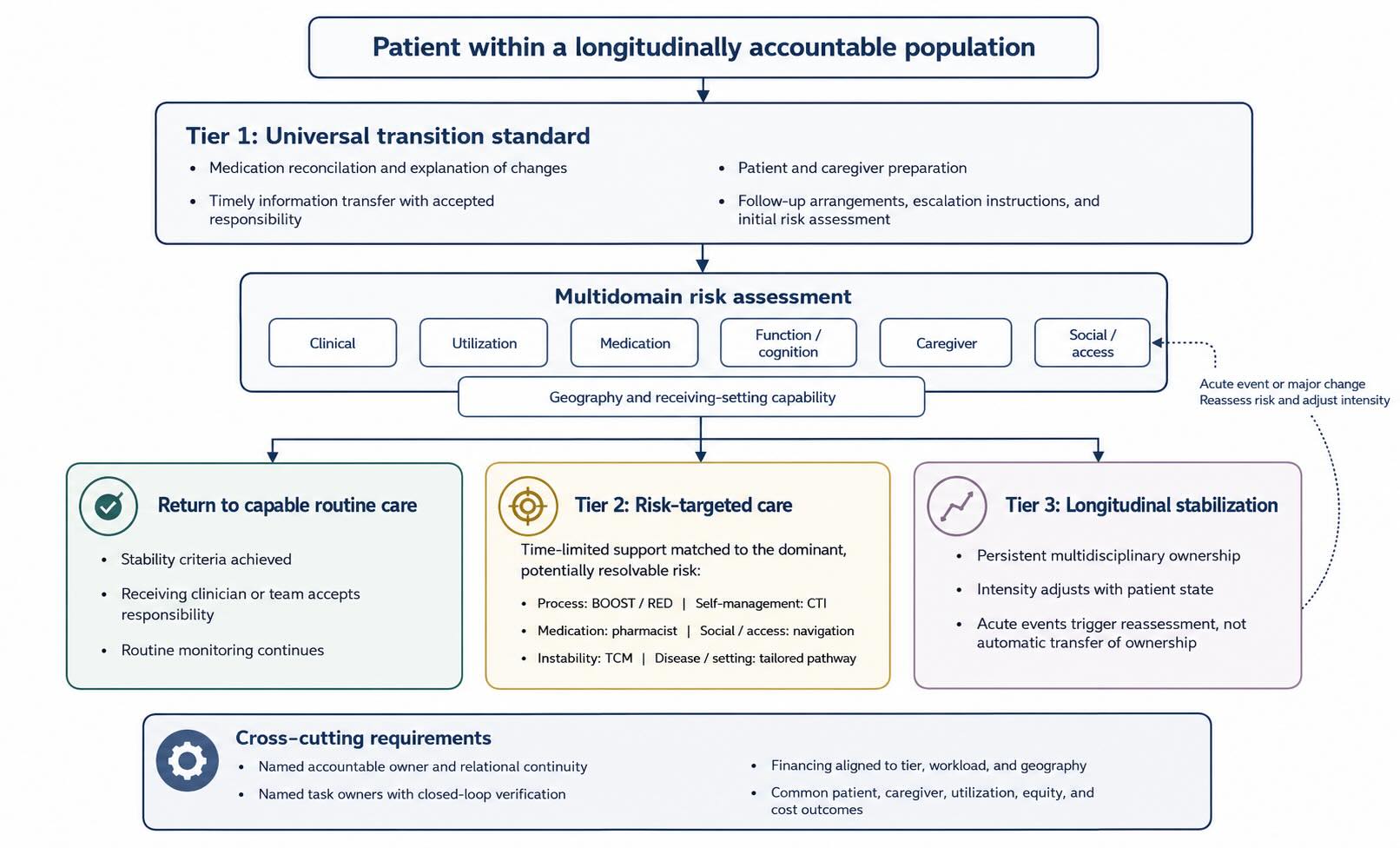
A risk-matched architecture for transitional care
The proposed framework combines a universal transition standard, multidomain risk assessment, targeted transitional intervention, and longitudinal stabilization for patients whose vulnerability persists across acute events.
Transition pathway
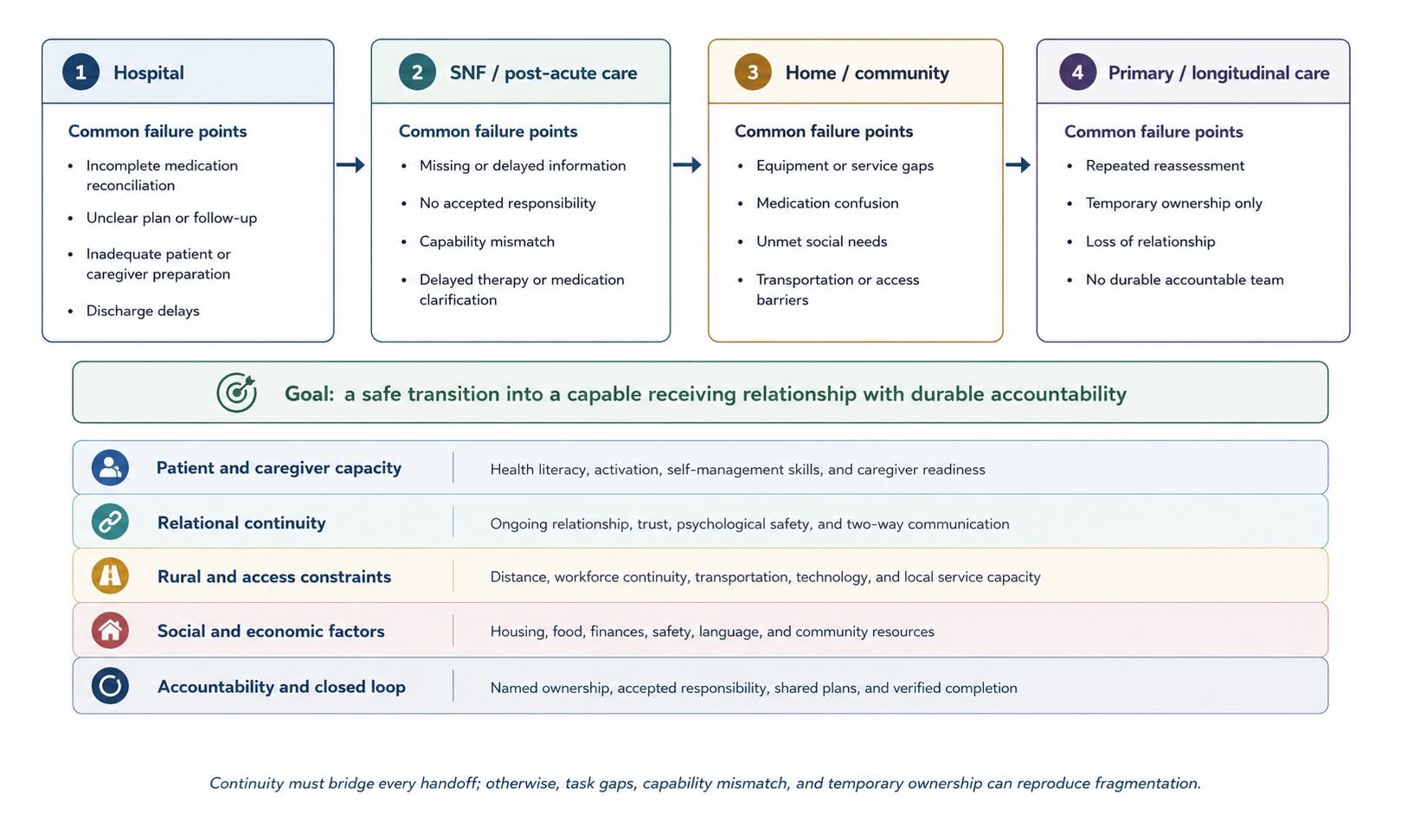
Where transitions fail—and what continuity must bridge
Transitional failures occur within settings and at the boundaries between them. A safe handoff requires more than sending information: the receiving organization must be capable of acting on the plan, responsibility must be accepted, and the patient and caregiver must be able to carry out the next steps.
Review approach
Comparative integrative narrative review
Evidence base
Trials, systematic and scoping reviews, economic evaluations, qualitative studies, implementation reports, and policy analyses.
Search approach
An author-curated full-text collection supplemented by gap-directed PubMed/MEDLINE and targeted publisher, government, and professional-organization searches conducted July 18–19, 2026.
Interpretation
Evidence was compared by mechanism, workforce, intensity, duration, setting, population fit, implementation requirements, outcomes, and economic perspective.
This was an iterative, gap-directed narrative review rather than a formal systematic review. It did not use duplicate independent screening, a PRISMA process, or comprehensive searches of every bibliographic database.
Funding and disclosures
This work was funded by Presidium Health Corp., the authors’ employer. All authors are employees and executive officers of Presidium Health. Presidium Health holds multiple contracts to provide transitions-of-care and related care-management services. These professional and financial interests could be perceived as influencing interpretation of the evidence and the proposed framework.
Read the complete white paper
Download the full report for the comparative model review, four evidence tables, proposed three-tier framework, economic and payment discussion, research agenda, and complete 31-source bibliography.
Questions about this white paper: info@presidiumhealth.com