Transitional Care Services: A Key to Enhanced Care Management
Transitional care bridges gaps between settings, prevents miscommunication, and enhances…
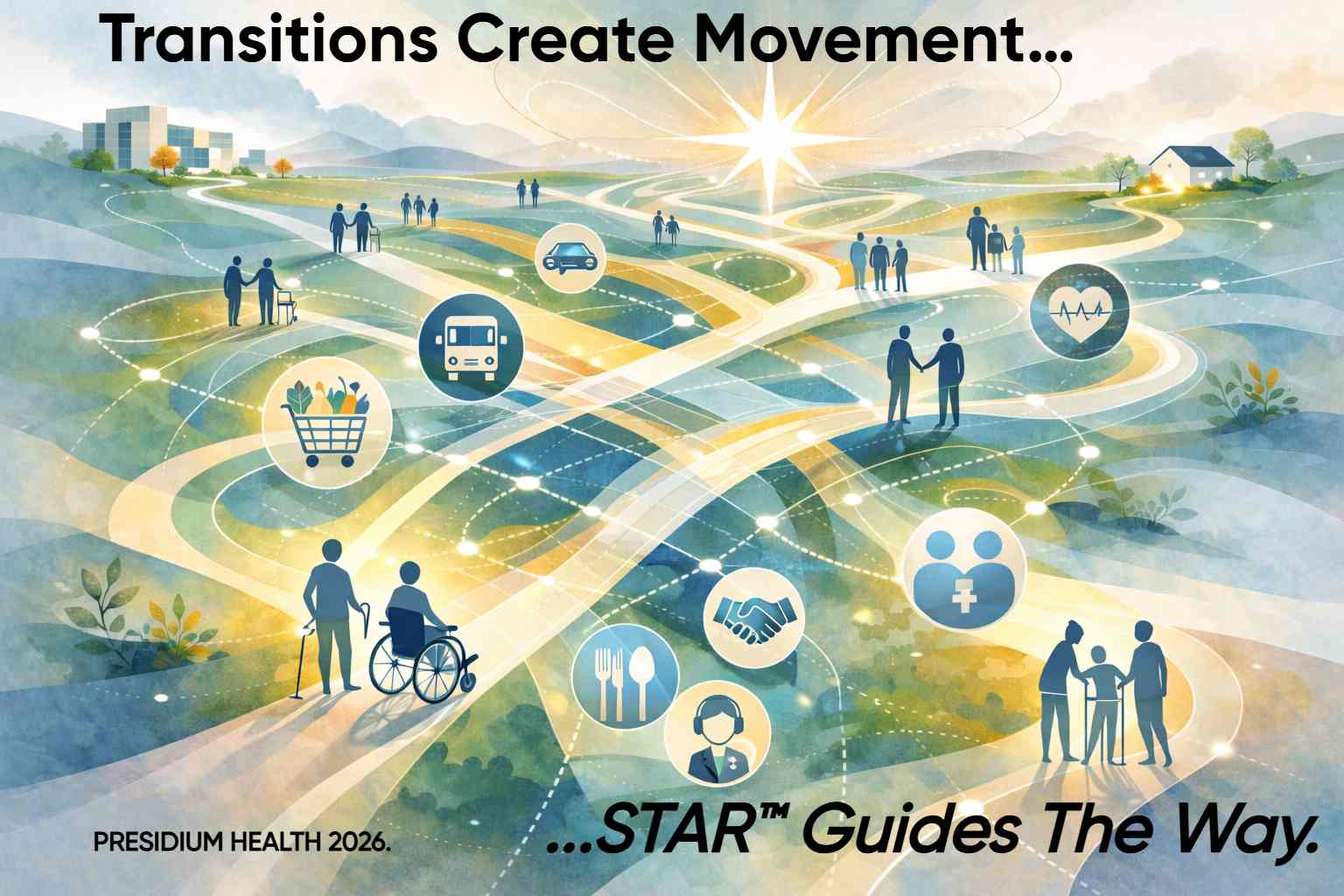
The period immediately following discharge — particularly after rehabilitation — is one of the most fragile points in a patient’s care journey. New functional limitations, medication changes, caregiver strain, financial stress, housing or social instability, and fragmented follow-up often converge within a compressed transition window.
Presidium Health delivers structured transitional care services that bring clarity, accountability, and continuity to this high-risk period — integrating clinical coordination with real-world social determinants of health to support stable recovery across settings.
Transitional care refers to coordinated clinical and operational services that support individuals as they move between care settings — particularly when medical, functional, or social risks increase.
High-quality transitional care goes beyond discharge instructions. It is a structured process designed to stabilize individuals during periods of elevated risk. This includes:
STAR™ (Safe Transition After Rehabilitation™) is Presidium Health’s structured delivery model for high-risk post-rehabilitation transitions.
STAR™ strengthens — rather than replaces — existing primary care, care management, and Enhanced Care Management (ECM) workflows by introducing clarity, defined processes, and structured escalation during the highest-risk transition window. It integrates medical coordination with structured assessment of functional and social risk factors that influence recovery.
Delivered through standardized workflows, STAR™ integrates across wraparound services, ECM care coordination, managed care, and delegated care models.
Rehabilitation discharges frequently involve layered shifts across clinical, functional, and social domains occurring simultaneously.
Patients may leave rehabilitation with:
The result is not simply discharge — but convergence. Without structured oversight, these compounded shifts increase the likelihood of fragmentation, medication interruption, or avoidable utilization.
Post-rehabilitation instability rarely occurs in isolation. Clinical, functional, social, and caregiver/access risks frequently shift simultaneously.
STAR™ is designed to stabilize this convergence of risk domains:
At the center of these converging forces is structured stabilization — coordinated oversight, defined accountability, proactive escalation, and continuity across settings.
Structured frameworks reduce variability and strengthen accountability during high-risk transition periods.
| Dimension | Variable Transitional Care Models | Presidium Health — STAR™ Delivery Model |
|---|---|---|
| Timing of Engagement | Begins after discharge | Activated prior to discharge |
| Workflow Design | Inconsistent | Structured, repeatable model |
| Ownership & Accountability | Diffuse | Defined and closed-loop |
| Medication Management | Documented | Verified with access confirmation |
| Risk Monitoring | 30-day readmission focus | Early clinical, functional, and social indicators |
| Social & Functional Integration | Situational | Embedded into structured assessment |
| Follow-Up Execution | Scheduled | Verified and escalated if needed |
| Access & Escalation | Business hours only | Defined escalation pathways with after-hours support |
| Documentation | Activity-based | Accountability-aligned continuity |
Structured transitional care reduces variability, strengthens accountability, and supports safer recoveries across settings. If you are exploring implementation, partnership opportunities, or integration within ECM, managed care, or delegated care models, Presidium Health is ready to collaborate.

Transitional care’s success is deeply influenced by non-medical factors like housing instability, transportation access, food insecurity, education, and social support. The most effective Transitional Care Programs bridge clinical care and social reality- transforming isolated interventions into equity-centered, human-first outcomes.
What starts at discharge doesn’t end there. Transitional Care lays the groundwork for successful Enhanced Care Management by identifying risks early, closing gaps in care, and building trust with high-need patients. See how seamless care transitions drive better outcomes—and set the stage for long-term stability.

Federal and state rulemaking continues to influence how care transitions are supported and reimbursed. From billing codes to compliance standards, understanding these shifts is essential for providers navigating value-based arrangements. Explore our policy insights to see how evolving regulations impact transitional care delivery.
Transitional care metrics often emphasize hospital readmissions, follow-up visits, and medication reconciliation — but these traditional measures miss the bigger picture. A drop in 30-day readmissions may look like success, yet patients can still cycle through emergency departments, observation stays, or skilled nursing facilities. Real success means showing that patients recover at home, avoid preventable setbacks, and experience better quality of life. To achieve this, health systems must move beyond lagging indicators and adopt upstream, patient-centered measures that reveal risks earlier and drive meaningful outcomes.


© 2024, Presidium Health, All rights reserved