
Research Highlight
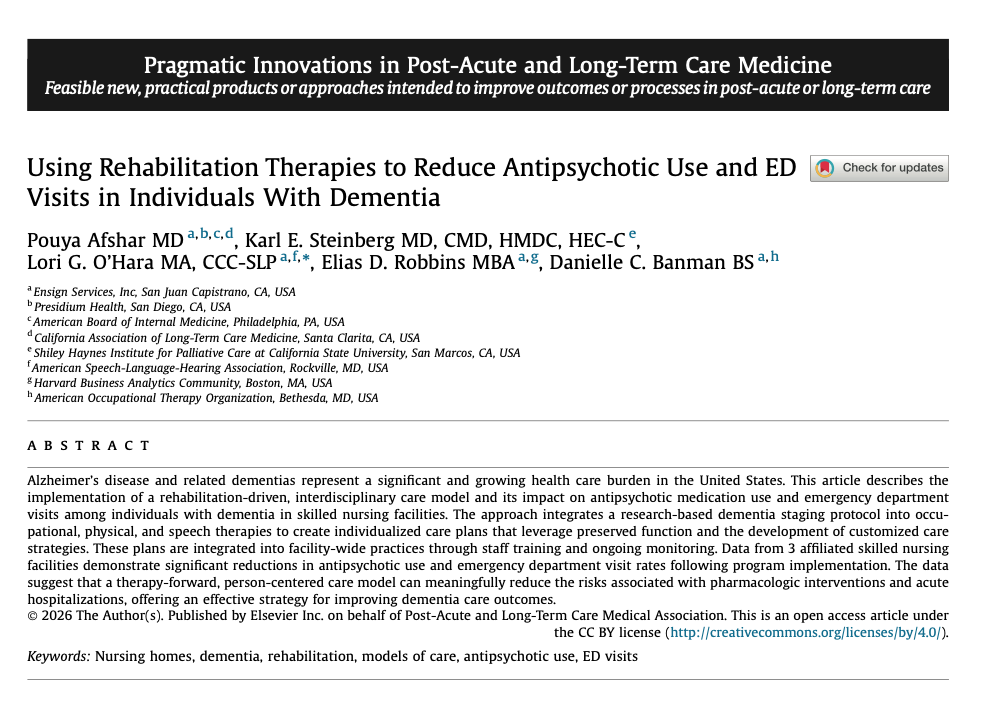
A rehabilitation-driven, interdisciplinary approach to person-centered dementia care in skilled nursing facilities.
Journal: Journal of the American Medical Directors Association (JAMDA)
Published: August 2026
Lead author: Pouya Afshar, MD, MBA
Dr. Afshar is affiliated with Presidium Health in addition to his other professional affiliations.
A Therapy-Forward Approach to Dementia Care
The model described in the article expands the role of occupational, physical, and speech therapy in the care of individuals with dementia.
Rather than focusing only on traditional rehabilitation goals, therapists use a research-based dementia staging approach to identify an individual resident’s cognitive abilities and preserved function.
The goal is not to restore cognitive abilities that have been lost. Instead, the care environment and daily interactions are adapted to the abilities the resident still retains.
Individualized strategies may address:
- Communication
- Verbal and visual cueing
- Activities
- Task sequencing
- Environmental modifications
- Sensory strategies
- Daily care routines
These approaches are incorporated into individualized care plans and communicated to the nursing, CNA, activities, therapy, and other facility staff who interact with the resident.
From Individual Assessment to Facility-Wide Practice
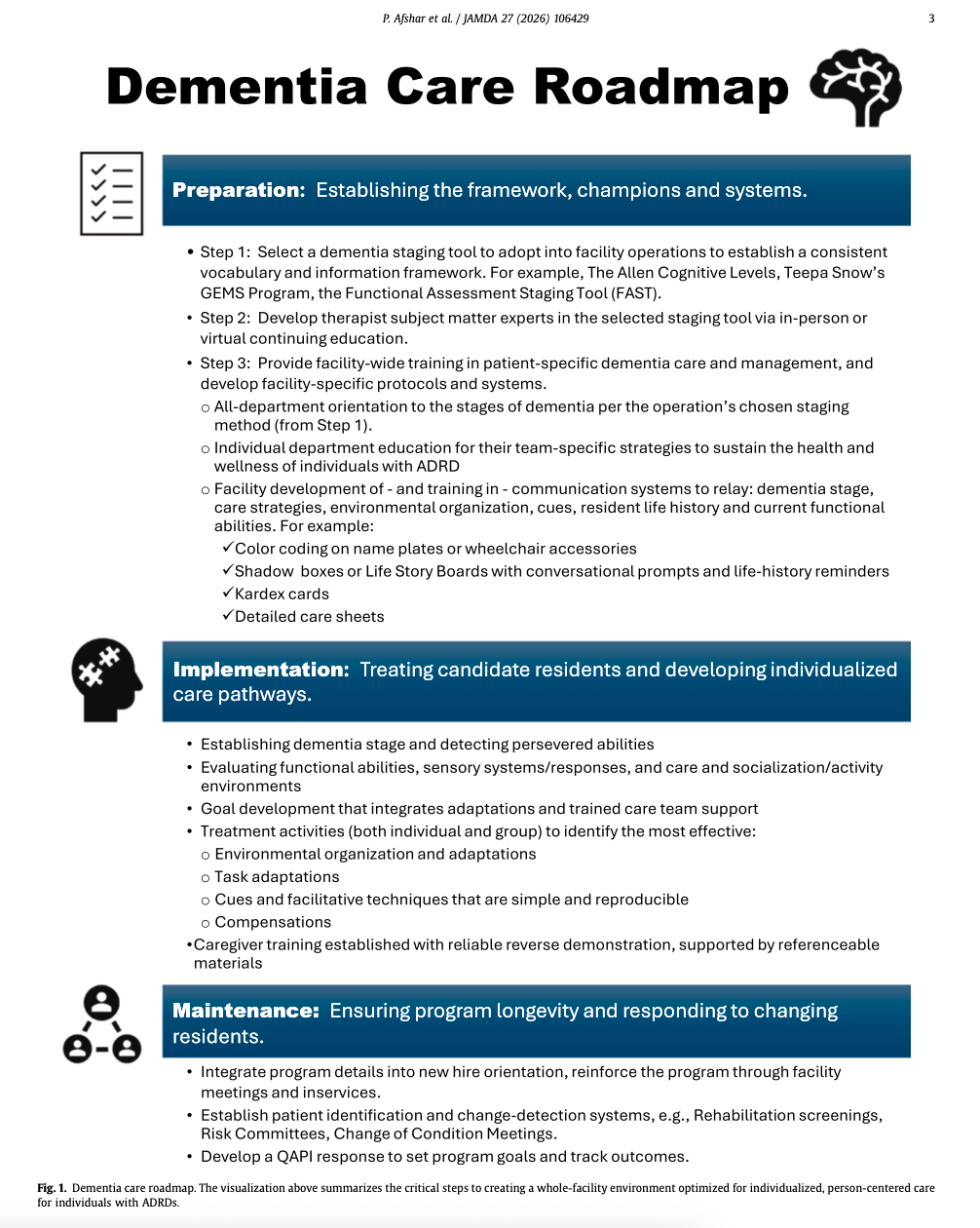
The model described by Afshar and colleagues includes three broad phases: preparation, implementation, and maintenance.
1. Preparation
Facilities select a dementia-staging methodology, develop therapy expertise in its application, and educate staff about the care model.
2. Implementation
Residents are assessed to identify cognitive level and preserved abilities. Therapists then develop individualized strategies intended to support function and address behavioral symptoms.
3. Maintenance
The approach becomes part of ongoing facility operations through staff education, continued screening, reassessment, and monitoring of outcomes.
Because dementia is progressive, strategies that are effective at one stage may need to be modified as a resident’s condition changes.
What the Facilities Observed
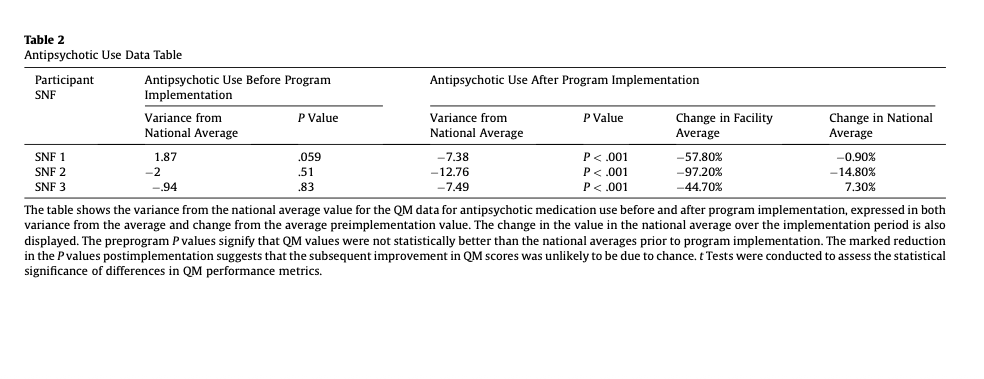
The authors retrospectively evaluated outcomes at three affiliated skilled nursing facilities that reported high engagement with the program.
Following implementation, all three facilities demonstrated substantial reductions in antipsychotic use compared with their pre-program levels.
57.8%Reduction at Facility 1
97.2%Reduction at Facility 2
44.7%Reduction at Facility 3
The facilities’ post-implementation antipsychotic rates were also significantly lower than the national benchmarks used in the analysis.
Emergency Department Utilization
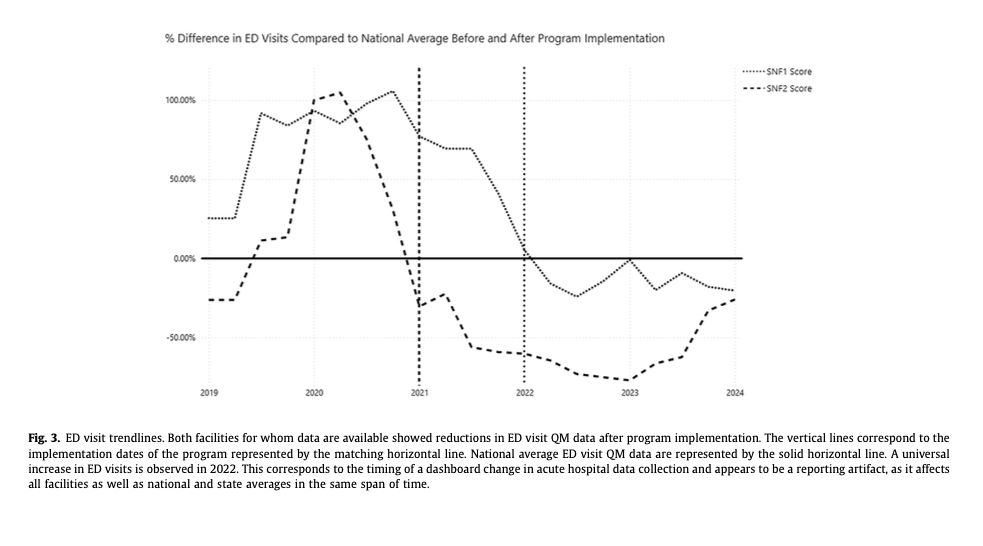
The authors also examined emergency department utilization.
Usable before-and-after ED data were available for two of the three facilities. Both began with ED utilization measures that were worse than the national comparison and subsequently moved below the national benchmark following implementation.
The improvement remained visible through the most recent CMS reporting periods evaluated in the article.
Why Rehabilitation Is Central to the Model
A central feature of the model is the use of rehabilitation professionals to translate cognitive assessment into specific care strategies.
Occupational, physical, and speech therapists can evaluate how cognitive impairment affects communication, mobility, activities, task performance, and interaction with the environment.
The resulting recommendations are intended to give caregivers practical, resident-specific approaches that can be incorporated into routine care.
Medical providers remain involved in medication management. When behavioral symptoms are adequately managed and clinically appropriate, gradual reduction of antipsychotic therapy can be considered while the interdisciplinary team continues to monitor the resident.
Cognitive assessment → Individualized strategy → Interdisciplinary implementation → Ongoing reassessment → Medication review
Important Study Limitations
The findings should be interpreted within the context of the study design.
This was a retrospective, pre- and post-implementation analysis, not a randomized controlled trial. There was no concurrent control group.
The three facilities were affiliated organizations selected in part because they demonstrated high engagement with the program, and program fidelity was not formally measured.
Other factors—including broader changes in nursing-home practice, regulatory efforts to reduce antipsychotic use, or changes in resident populations—could also have contributed to the observed outcomes.
Accordingly, the study demonstrates an association between implementation of the care model and improved measured outcomes at these facilities. It does not establish that the intervention alone caused those improvements, nor does it establish that similar results will occur in other facilities.
Further evaluation across additional facilities and with more rigorous study designs would help determine the model’s effectiveness and generalizability.
Read the Article
The full article provides additional detail on the dementia-staging approach, implementation roadmap, interdisciplinary responsibilities, facility outcomes, and study limitations.